
Myrugy
Carro 0
  • Home
  • DIY Rug Kits
  • Custom Rugs
  • Workshops & Experiences
    • Private Group Events 🎉
    • upcoming Workshops & Experiences
  • Shop
Mi cuenta
Acceso Registro
  • Home
  • DIY Rug Kits
  • Custom Rugs
  • Workshops & Experiences
    • Private Group Events 🎉
    • upcoming Workshops & Experiences
  • Shop
Myrugy
Cuenta Lista de deseos Carro 0

busca en nuestra tienda

Myrugy
Cuenta Lista de deseos Carro 0
News

A Deep Dive into Berber Weaving Techniques

por ayoub boullam en Jul 11, 2025
A Deep Dive into Berber Weaving Techniques

To the untrained eye, a Moroccan Berber rug is a beautiful object—a cozy, geometrically patterned textile perfect for adding warmth and style to a room. But to truly appreciate one is to understand that it is a story told in wool and dye, a piece of cultural history created using techniques that have been passed down through countless generations of Amazigh (Berber) women.

These are not just decorative items; they are the result of immense skill, patience, and a deep, ancestral knowledge of the loom. To understand these techniques is to be able to read the language of the rug itself.

Let's take a deep dive into the fundamental techniques that bring a traditional Berber rug to life.

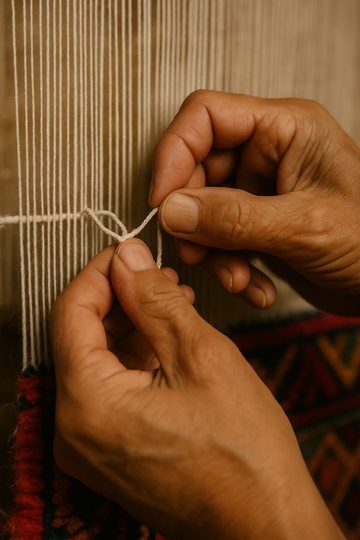
A close-up, detailed shot of a weaver's hands tying a knot on a vertical loom, with the pattern of the rug emerging below.


1. The Loom: The Foundation of Creation

The traditional Berber loom is a model of elegant simplicity and functionality. Typically it is a vertical loom, often made of wood, which could be easily disassembled and transported—a crucial feature for the historically nomadic tribes of the Atlas Mountains.

The loom consists of two main beams, between which the vertical threads, known as the warp, are stretched under tension. The warp forms the skeleton of the rug; it is the foundation upon which every knot is tied and every line of weft is passed. The final length of the rug is determined by the length of the warp, and its width by the width of the loom.

Want to see a traditional loom in action? Join us for an authentic rug-making workshop in Marrakech.

2. The Wool: The Soul of the Rug

The soul of an authentic Berber rug comes from its primary material: the wool from the sheep of the High Atlas mountains. This wool is prized for its durability, its high lanolin content (which makes it soft and stain-resistant), and its rich, creamy color.

Before it can be used, the raw wool goes through a painstaking process:

  • Cleaning: The wool is washed, often in a local river, to remove dirt and impurities.

  • Carding: It is then "carded" or combed with large, nail-studded paddles to align all the fibers in the same direction.

  • Spinning: Finally, the carded wool is meticulously hand-spun using a simple wooden spindle (izdi) to twist the fibers into strong, consistent yarn ready for dyeing and weaving.

3. The Knot: The Language of the Rug

This is the most critical and time-consuming part of creating a pile rug. While different cultures use different knots, Moroccan Berber rugs are famous for their use of the Symmetrical Knot, also known as the Ghiordes knot or Turkish knot.

Here’s how it works: a short piece of yarn is passed over two adjacent warp threads and then pulled through from between them, creating a secure knot. The two ends of the knot stick out to form the plush "pile" of the rug.

This technique, where each knot is individually and securely tied, is what makes Berber rugs so incredibly durable and long-lasting. A single rug can contain tens of thousands, or even hundreds of thousands, of these hand-tied knots.

Curious to try it yourself? Book a workshop or learn with our at-home kit.

4. The Weft & Flatweave: The Structural Story

The knots are not the only part of the weave. In between every single row of knots, the weaver passes a thread of yarn, called the weft, horizontally through the warp threads. They pass it over one warp thread and under the next, alternating with each pass.

This weft thread is then tightly beaten down against the row of knots using a heavy comb-like tool called a tazekka. This crucial step locks the knots in place and creates the tight, strong structure of the rug.

Sometimes, the weaver will create entire sections using only this weft technique, without any knots. This creates a flat, non-plush area known as a kilim weave. You often see this at the ends of a rug, creating a beautiful textural contrast.

5. The Symbols: Weaving a Narrative

It is through the combination of these techniques—the patient tying of thousands of symmetrical knots and the structural passing of the weft—that the weaver creates the iconic symbols of Berber design. The diamond, representing femininity and protection; the chevron, representing fertility; the zigzag, representing rivers or life's journey. Each symbol is painstakingly built, row by row, knot by knot.

Reading about these techniques provides an appreciation for the craft, but there is no substitute for feeling the wool and tying the knots yourself. In a hands-on environment like the MyRugy Workshop, our instructors don't just teach you the motions; they share the feeling and rhythm of these ancient techniques, connecting you to the long line of weavers who came before.

Want to decode more rug symbols? Read our guide to Berber motifs and meanings.


Reading about these techniques provides an appreciation for the craft, but there is no substitute for feeling the wool and tying the knots yourself. In a hands-on environment like the MyRugy Workshop, our instructors don’t just teach you the motions; they share the feeling and rhythm of these ancient techniques, connecting you to the long line of weavers who came before.

Anterior
5 Hands-On Artisan Workshops to Try in Marrakech
Próximo
A Guide to Getting Around Marrakech: Taxis, Buses, and Walking

Artículos relacionados

What to Do in Marrakech on Valentine’s Day: A Romantic Weaving Workshop

What to Do in Marrakech on Valentine’s Day: A Romantic Weaving Workshop

Best Valentine’s Day Experience for Couples in Marrakech: Weaving Memories at MyRugy Workshop Studio

Best Valentine’s Day Experience for Couples in Marrakech: Weaving Memories at MyRugy Workshop Studio

Romantic Craft Workshop in Marrakech for Valentine’s Day

Romantic Craft Workshop in Marrakech for Valentine’s Day

Valentine’s Day in Marrakech: Romantic Activities for Couples

Valentine’s Day in Marrakech: Romantic Activities for Couples

Tags

  • 3D rug sculpting
  • authentic craft workshop Marrakech
  • authentic Moroccan craft
  • authentic Moroccan craft experience
  • authentic weaving experience
  • Berber rug making class
  • Berber rug making experience
  • best rooftops marrakech
  • best time to visit marrakech
  • best Valentine’s Day experience for couples in Marrakech
  • Biodegradable yarn
  • color psychology in fiber arts
  • corporate wellness trends
  • couple activities Marrakech
  • couples activities Marrakech
  • couples craft workshop Marrakech
  • couples weaving workshop Marrakech
  • creative hobby gifts
  • creative team building ideas
  • custom rug design
  • day trips from marrakech
  • DIY rug frame
  • DIY rug kits refill
  • DIY rug making kit
  • djemaa el fna food
  • Eco-friendly crafting
  • ergonomic frame loom
  • Ethical wool sourcing
  • fiber art gifts
  • fiber arts education
  • fix loose warp
  • fixing hourglass weaving
  • Frame loom techniques
  • hands-on cultural activities Marrakech
  • how to haggle in morocco
  • How to Weave a Moroccan Rug from Scratch at Home
  • instagram spots marrakech
  • leftover yarn projects
  • loom tension adjustment
  • loom tension guide
  • loom weaving for beginners
  • marrakech souks guide
  • Marrakech Valentine's Day ideas
  • Marrakech weaving workshop
  • marrakech with kids
  • mindful hobbies
  • Moroccan craft experience
  • Moroccan rug making experience
  • Moroccan rug weaving workshop
  • moroccan rugs
  • MyRugy Academy advanced lessons
  • MyRugy Academy background
  • MyRugy Academy benefits
  • MyRugy Academy color theory
  • MyRugy Academy culture
  • MyRugy Academy curriculum
  • MyRugy Academy daily routine
  • MyRugy Academy design course
  • MyRugy Academy final steps
  • MyRugy Academy free lesson
  • MyRugy Academy group access
  • MyRugy Academy help
  • MyRugy Academy material guide
  • MyRugy Academy mindfulness
  • MyRugy Academy mini projects
  • MyRugy Academy mobile app
  • MyRugy Academy patterns
  • MyRugy Academy projects
  • MyRugy Academy requirements
  • MyRugy Academy student login
  • MyRugy Academy subscription
  • MyRugy Academy values
  • MyRugy Academy workspace
  • MyRugy Box authenticity
  • MyRugy Box corporate gift
  • MyRugy Box customization
  • MyRugy Box gift idea
  • MyRugy Box levels
  • MyRugy Box materials
  • MyRugy Box organization
  • MyRugy Box origin
  • MyRugy Box preparation
  • MyRugy Box recycling
  • MyRugy Box refill
  • MyRugy Box review
  • MyRugy Box self-care
  • MyRugy Box size
  • MyRugy Box storage
  • MyRugy Box tools
  • MyRugy Box tools list
  • MyRugy Box travel
  • MyRugy Box unboxing
  • MyRugy brand ecosystem
  • myrugy craft box review
  • MyRugy Loom anxiety relief
  • MyRugy Loom combs
  • MyRugy Loom compatibility
  • MyRugy Loom craftsmanship
  • MyRugy Loom design
  • MyRugy Loom design source
  • MyRugy Loom dimensions
  • MyRugy Loom features
  • MyRugy Loom finishing
  • MyRugy Loom pattern
  • MyRugy Loom portable
  • MyRugy Loom present
  • MyRugy Loom problems
  • MyRugy Loom progression
  • MyRugy Loom projects
  • MyRugy Loom reuse
  • MyRugy Loom setup
  • MyRugy Loom small weave
  • MyRugy Loom team building
  • MyRugy Loom tension
  • MyRugy Loom warp
  • MyRugy Loom weaving time
  • MyRugy Loom wood source
  • myrugy vs
  • MyRugy Wool bundle
  • MyRugy Wool calculation
  • MyRugy Wool cleaning
  • MyRugy Wool colors
  • MyRugy Wool dye process
  • MyRugy Wool eco-friendly
  • MyRugy Wool grading
  • MyRugy Wool knotting
  • MyRugy Wool knotting issues
  • MyRugy Wool needles
  • MyRugy Wool origin
  • MyRugy Wool packing
  • MyRugy Wool packs
  • MyRugy Wool preparation
  • MyRugy Wool quantity
  • MyRugy Wool scraps
  • MyRugy Wool sensory
  • MyRugy Wool storage
  • MyRugy Wool sustainability
  • MyRugy Wool techniques
  • MyRugy Wool texture
  • MyRugy Wool vs regular yarn
  • MyRugy Wool workshops
  • myrugy workshop studio
  • MyRugy Workshop Studio advice
  • MyRugy Workshop Studio care
  • MyRugy Workshop Studio equipment
  • MyRugy Workshop Studio ethics
  • MyRugy Workshop Studio expert tips
  • MyRugy Workshop Studio follow up
  • MyRugy Workshop Studio gift card
  • MyRugy Workshop Studio inspiration
  • MyRugy Workshop Studio layout
  • MyRugy Workshop Studio looms
  • MyRugy Workshop Studio masterclass
  • MyRugy Workshop Studio palette
  • MyRugy Workshop Studio retreat
  • MyRugy Workshop Studio standards
  • MyRugy Workshop Studio sustainability
  • MyRugy Workshop Studio technique
  • MyRugy Workshop Studio tour
  • MyRugy Workshop Studio tradition
  • MyRugy Workshop Studio trends
  • MyRugy Workshop Studio virtual tour
  • MyRugy’s DIY rug kits
  • portable loom weaving
  • premium wool for weaving
  • remote employee engagement
  • romantic experiences Marrakech
  • romantic things to do in Marrakech
  • rug design software
  • rug knot anatomy
  • rug making equipment
  • rug making guide
  • Rug making materials
  • rug making mechanics
  • rug making wool
  • rug making workshop
  • rug making workspace ideas
  • rug making yarn selection
  • rug tufting at home
  • rug tufting color palettes
  • rug tufting guide
  • rug tufting kit
  • rug tufting techniques
  • rug weaving workshop Marrakech
  • rug yarn tensile strength
  • scrap wool ideas
  • small batch wool dyeing
  • Studio quality wool
  • sustainable rug making
  • Sustainable rug tufting
  • sustainable weaving kits
  • sustainable yarn for tufting
  • tapestry weaving tips
  • Textile art education
  • textile arts workshop
  • therapeutic crafting
  • travel weaving tips
  • tufting frame size guide
  • tufting gun maintenance
  • tufting gun pile height
  • tufting gun tips
  • tufting loom assembly
  • tufting maintenance
  • tufting starter kit
  • tufting studio organization
  • tufting wool vs knitting yarn
  • unique things to do in Marrakech
  • Valentine's Day Marrakech
  • Valentine's Day Marrakech ideas
  • Warping tools MyRugy
  • Weaving academy kit
  • weaving at home
  • weaving for beginners
  • weaving for mental health
  • Weaving Kits
  • weaving loom maintenance
  • weaving on a plane
  • Weaving tools
  • weaving troubleshooting
  • Weaving wool
  • what is a riad marrakech
  • wool yarn selection guide
  • Workshop
  • yarn storage for tufting
  • zero waste weaving

Instagram

Let’s get in touch

Sign up for our newsletter and receive 10% off your

Main menu

  • Home
  • DIY Rug Kits
  • Custom Rugs
  • Workshops & Experiences
  • Shop

Information

  • 🌿 Our Mission
  • About Us
  • News
  • MyRugy Academy
  • Become a Partner
  • Affiliate Program
  • Terms of Service
  • Refund & Return Policy
  • Privacy Policy
  • Shipping & Delivery
  • Custom Order Policy

Our store

© Myrugy 2025
Opciones de pago:
  • American Express
  • Apple Pay
  • Diners Club
  • Discover
  • Google Pay
  • Mastercard
  • Shop Pay
  • Visa
Carro 0

Confirm your age

Are you 18 years old or older?

Come back when you're older

Sorry, the content of this store can't be seen by a younger audience. Come back when you're older.

Carro de la compra

Su carrito está vacío.
Agregar nota para el vendedor
Estimar las tarifas de envío
Añadir un código de descuento
Total parcial $0.00
Ver carrito